


ECHO Award 2026
Call for nominations ECHO Award 2026
We are pleased to open the call for nominations for the ECHO Award 2026. Through this annual call, ECHO invites universities of applied sciences and research universities to nominate students who contribute to structural change through self-aware leadership and social engagement.
Below you will find the full call, including the categories, criteria, and practical information about the nomination procedure.
Categories ECHO Award 2026
With the ECHO Award, we recognize and celebrate students with a non-Western background who contribute to structural change in society through self-aware identity and leadership.
In 2026, we will present three ECHO Awards to students who distinguish themselves through the impact they create on urgent societal issues:
- ECHO Award – Universities of Applied Sciences (HBO)
- ECHO Award – Research Universities (WO)
- Current Affairs Award (cross-category)
The Current Affairs Award gives the jury the opportunity to look across categories and recognize candidates who respond to urgent societal developments.
Criteria ECHO Award 2026
Students eligible for an ECHO Award are students with a non-Western background who demonstrate:
- Societal impact: Tangible contributions that lead to positive change, within and/or beyond their educational institution, on socially relevant issues.
- Policy and systemic change: Commitment to policy-related and/or systemic challenges aimed at addressing structural inequality, accompanied by a clear vision and strategy.
- Leadership qualities: Inspiring and connecting leadership, with the ability to mobilize others and realize sustainable change.
The ECHO Award recognizes the unique experiences of students with a non-Western background* and how they translate these experiences into constructive contributions toward a more inclusive and just society.
Diversity in Disciplines and Innovation
De jury heeft expliciet aangegeven het belangrijk te vinden dat de voordrachten een brede diversiteit aan studierichtingen en disciplines weerspiegelen. In de afgelopen jaren zien we dat een aanzienlijk deel van de voordrachten afkomstig is uit de (bio)medische en gezondheidsgerelateerde opleidingen. Deze studenten leveren waardevolle en indrukwekkende bijdragen — en blijven vanzelfsprekend welkom in de voordrachten.
At the same time, the jury observes that other disciplines are relatively less visible in the nomination pool. To reflect the full breadth of societal leadership within higher education, we strongly encourage institutions to broaden their perspective. We invite institutions to:
- Actively search across different faculties and fields of study, including arts and cultural programs, technical and design-oriented studies, economics and business programs, teacher education, social sciences, humanities, and interdisciplinary programs.
- Consider students who create societal impact through entrepreneurship, technology, art, policy, education, communication, data, law, sustainability, or community-based initiatives.
- Nominate not only “well-known” or traditional leadership profiles (such as students with visible board positions or classical excellence trajectories), but also students who create change in less conventional ways.
- Create space for innovative forms of leadership, such as collective leadership, artistic activism, social entrepreneurship, grassroots organizing, digital innovation, or bridge-building between communities.
The jury is explicitly looking for renewal in profiles, perspectives, and areas of impact. Societal impact manifests itself in many forms—not only in healthcare and policy, but also in technology, arts, education, economics, sustainability, data, law, culture, and community organizing.
By consciously broadening the scope of nominations, institutions can help create a nomination field that reflects the full diversity of talent, vision, and societal engagement within higher education.
Prize
The winners will be selected by an independent jury and will receive a fully funded summer course at UCLA in the United States in 2027.
(The summer course at UCLA is subject to availability. If participation proves not to be possible, a suitable alternative will be arranged in consultation with the winners.)
How do I nominate a candidate?
Read more about the nomination procedure here.
Deadline nominations: Friday June 26, 2026
Please note: internal deadlines may differ per institution. If you have questions about this, please contact your institution’s internal coordinator or ECHO (pravini@echo-net.nl).
* For the definition of “non-Western,” ECHO refers to the framework used by the Statistics Netherlands (CBS): “A person whose migration background originates from one of the countries in Africa, Latin America, or Asia (excluding Indonesia and Japan), or Turkey.” Because CBS bases this definition primarily on a socio-economic perspective, while ECHO’s work is grounded in a socio-societal perspective within the Dutch context, ECHO chooses to include Indonesia and Japan within its “non-Western” framework.
For further frameworks and concepts, we kindly refer you to the Teaching & Learning Center (TLC). This platform offers educators, professionals, and students access to knowledge and inspiration on diversity and inclusion in education.
Agenda ECHO Award 2026
Monday 9 March 2026:
Call for nominations open
Fiday 26 June 2026:
Deadline nominations
Saturday 5 September 2026:
ECHO Ambassador Academy
Thursday 24 September 2026:
Jury delibaration – selection finalists
Friday 25 September 2026:
Announcement finalists
Thursday 29 October 2026:
Jury conversations with finalists
Thursday 10 December 2026 (subject to change)
ECHO Award Ceremony
Please note: internal deadlines may differ per institution. If you have questions about this, please contact your institution’s internal coordinator or ECHO (pravini@echo-net.nl).

Recap
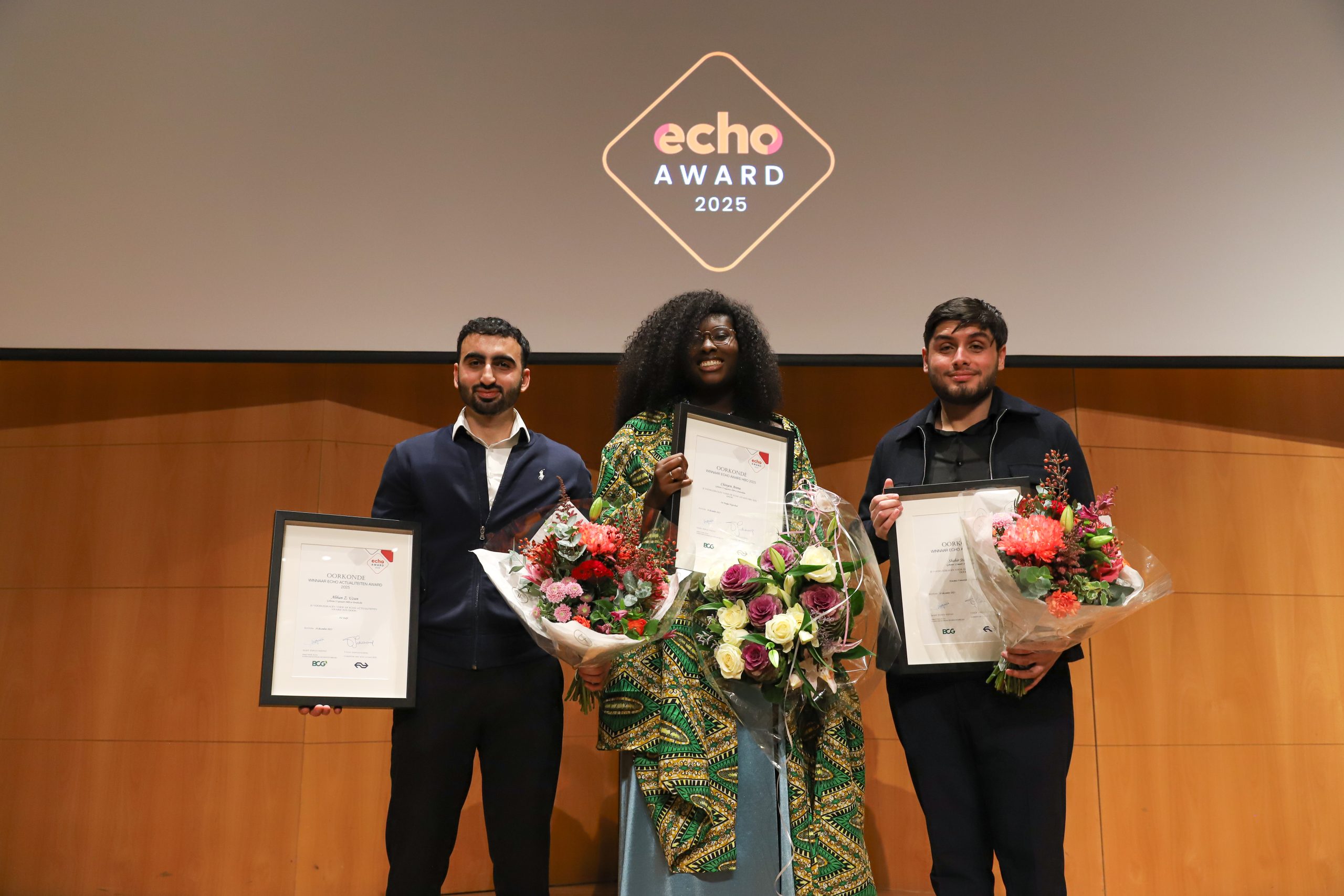
ECHO Award 2025
Read more about the nominees, finalists and award ceremony of last year’s ECHO Award.